- Feb 19, 2025
- 5 min read
Possible Historical Figures in Assassin's Creed Shadows
Written by Adam
Article first published March 12, 2024
If Assassin’s Creed is known for anything, it’s how it moulds its fictional stories and universe into historical reality.
From recreating the lost city of Baghdad in Assassin’s Creed Mirage to respectfully portraying Kanien'kehá:ka heritage and culture in Assassin’s Creed III, Ubisoft has gone above and beyond to ensure that history remains authentic and accurate as much as possible within the Assassin’s Creed universe. This is unlikely to change with the latest instalment, Assassin’s Creed Shadows, on the horizon.
From the teaser trailer shown at the Assassin’s Creed 15th Anniversary celebration livestream, Shadows will finally allow us to explore the much-awaited setting of Feudal Japan within the Assassin’s Creed universe.
From the trailer, the information given at the event and rumours swirling around the internet, we will be playing as two protagonists, a female Ninja or ‘Kunoichi’ and a male Samurai named Yusuke.
These snippets of information are crucial because they tell me that Assassin’s Creed Shadows will be set in the Sengoku Period.
Ninja, in historical terms, vanished as quickly as they came, only being active for around 200 years. And Yasuke was only active in this period from 1579 to 1582 before never being heard from again.
With that in mind, let’s explore some of the historical characters likely to make an appearance in Assassin’s Creed Shadows!
Oda Nobunaga
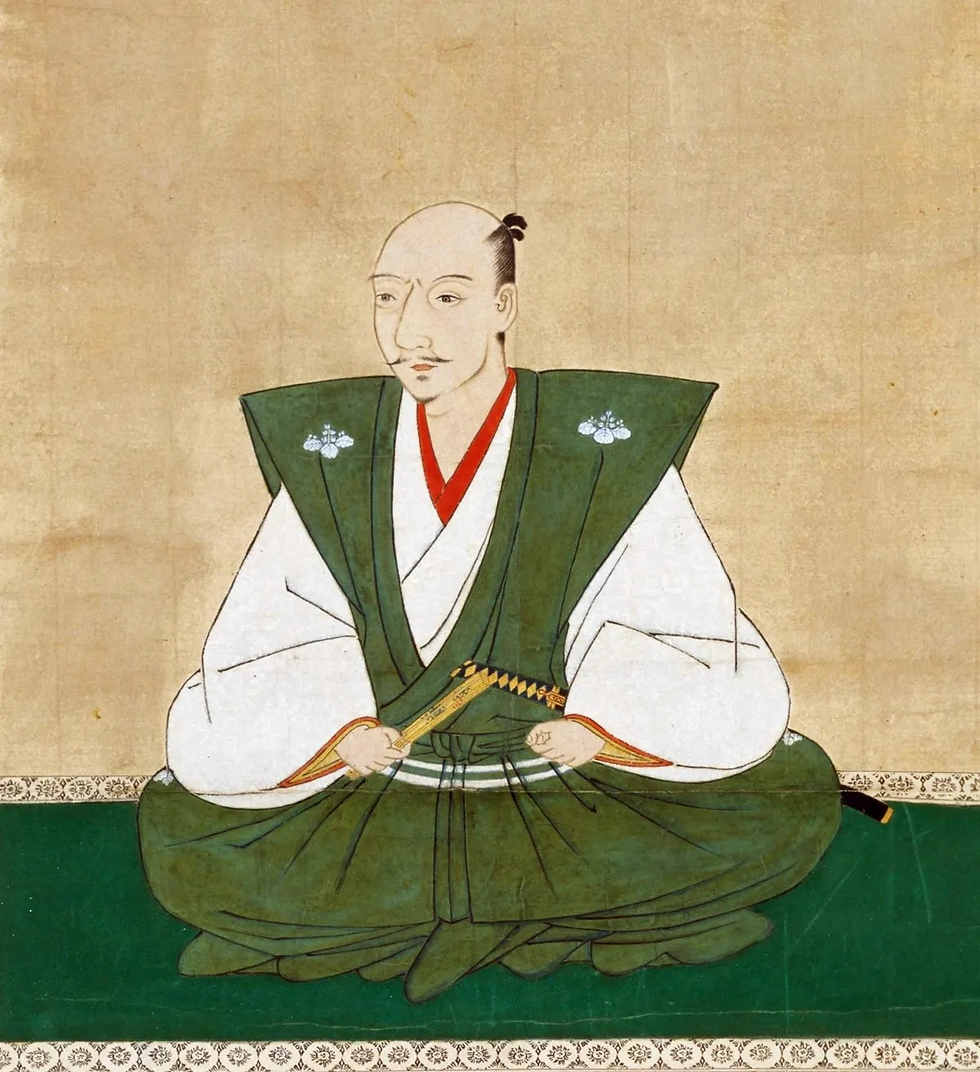
Portrait of Oda Nobunaga in colour on paper, by Kanō Motohide (1583, in Chōkō-ji, Important Cultural Property)
Billed as one of the “Three Great Unifiers of Japan” (we’ll get to the others later), Nobunaga was head of the powerful Oda clan that waged war against the other daimyos (feudal lords) in 1560 in a bid to unify Japan.
Known for his strange and brutal behaviour, Nobunaga’s reign was punctuated by innovative military tactics, the fostering of free trade, reforms of Japan's civil government, and the advent of the Momoyama historical art period, but also for the unrelenting suppression of those that stood against him.
His reign came to an end in 1582 during the Honnō-ji incident in which his retainer, Akechi Mitsuhide ambushed him in Kyoto, forcing him to commit seppuku.
Now, I believe that both protagonists in Assassin’s Creed Red will be intrinsically tied to Nobunaga. Bear with me, it’s theory time!
As we know, the female protagonist is rumoured to be a Ninja or Shinobi out for revenge. In popular culture, the Iga people are said to be a clan of Ninja. This isn’t strictly true of course, but what is true, is that Nobunaga invaded Iga twice in what’s known as the Tenshō Iga War.
The first attempt, led by his son, Oda Nobukatsu, was unsuccessful. The second attempt was different. With Nobunaga at the helm, Iga was brought to heel.
I think that in this instance, Ubisoft will combine pop culture and historical fact and have one of the protagonists seeking revenge against Nobunaga for the destruction of her people and homeland.
As for Yasuke, he was a loyal retainer to Nobunaga until his death in 1582. This may be a stretch but perhaps the two protagonists will be enemies, one protecting Nobunaga and the other out to assassinate him? Something to think about.
Yasuke

Yasuke, as he appears in Netflix’s Yasuke - Netflix
There is very little documented information about Yasuke. He is likely to have been born in Mozambique but his real name, family structure, place of birth, ethnicity and date of birth are in doubt.
However, there are no doubts that he has African roots, as François Solier's Histoire Ecclesiastique Des Isles Et Royaumes Du Japon states that he was from Portuguese East Africa (now called Mozambique).
Nobunaga gifted him the name Yasuke and the rank of retainer who was employed and given a stipend by him. He was also a weapons bearer.
There really isn’t much to say about Yasuke and this where I’m hoping Ubisoft can get creative and fill in the blanks.
Toyotomi Hideyoshi

Important cultural property "Toyotomi Hideyoshi portrait" (part of artwork). Acclaimed in the 3rd year of Keicho (1598), Kōdai-ji Temple, Kyoto.
Regarded as the second ”Great Unifier of Japan”, Toyotomi Hideyoshi rose from a humble peasant background as a retainer to Oda Nobunaga to become one of the most powerful men in Japanese history.
He rose to power after the death of Nobunaga at the Honnō-ji incident and left a long-standing legacy behind at the time of his death in 1598 including Osaka Castle, the Tokugawa class system, the restriction on the possession of weapons to the samurai, and the construction and restoration of many temples, some of which are still visible in Kyoto.
Perhaps the most enduring event of his career as Chancellor of the Realm was the invasion of Korea in 1592 in which he saw great success initially but as time marched on, the war reached a stalemate, damaging his prestige by the time of his death in 1598.
Tokugawa Ieyasu

Portrait of Tokugawa Ieyasu - Kanō Tan'yū
The third and final “Great Unifier of Japan”, Tokugawa Ieyasu is arguably the most famous. Calculating and subtle, Ieyasu spent most of life weaving alliances and navigating the complexities of Feudal Japan’s cutthroat politics.
Having spent most of his childhood as a hostage to his father’s rival, Oda Nobuhide (Nobunaga’s father), he knew when to tread carefully and when to be bold.
He was also capable of great loyalty, having never betrayed Nobunaga despite his bloody past with his family.
After winning the Battle of Sekigahara, the most decisive battle in Feudal Japan’s history, Ieyasu became the de facto ruler of Japan which led to the Tokugawa shōgunate being established.
He was also ruthless, executing Toyotomi Hideyoshi’s son, Hideyori, his mother and infant son, after a lengthy siege of Osaka Castle to solidify the Tokugawa shōgunate’s grip on Japan. It‘s worth noting that he regretted this act for the rest of his life.
The Tokugawa shōgunate unified Japan, bringing to a close, the most brutal and bloody period in Japanese history and enduring for 265 years from 1603 until the Meiji Restoration in 1868.
Under the Tokugawa shōgunate’s rule, Japan flourished, experiencing massive growth and urbanisation, leading to the formation of the merchant class and Ukiyo culture.
But it was also a period of isolationist policies and a strict hierarchical class system, the effects of which are still felt today.
Hattori Hanzō

Portrait of Hattori Hanzo from the 17th Century
If you’re interested in Japanese history, you’ll have probably heard of this man. Hattori Hanzō, also known as “Demon Hanzō” is a popular figure both in and outside of Japan.
When many people talk about Hattori Hanzō, they are referring to one person, but the name is really more of a moniker which references multiple people in the family.
Hanzō is, of course, popularised as a Ninja. This is true as he was a Ninja. But he was also a Samurai. The two are not mutually exclusive and were often interchangeable depending on what was required.
I could see Ubisoft employing him as a mentor figure for our female protagonist. Maybe have Hanzō work with her to get revenge on Nobunaga since Iga was decimated by him and was home to the Hattori family.
These are only a few historical figures we could encounter and interact with in Assassin’s Creed Shadows.
There are more that haven’t been mentioned in this article, such as Kojiro Sasaki or his rival Miyamoto Musashi, arguably the greatest Samurai in history.
If you enjoyed this article be sure to follow Scholars of the Creed on BlueSky for more content on the art, history and science of the Assassin's Creed Universe. Safety and peace be upon you.